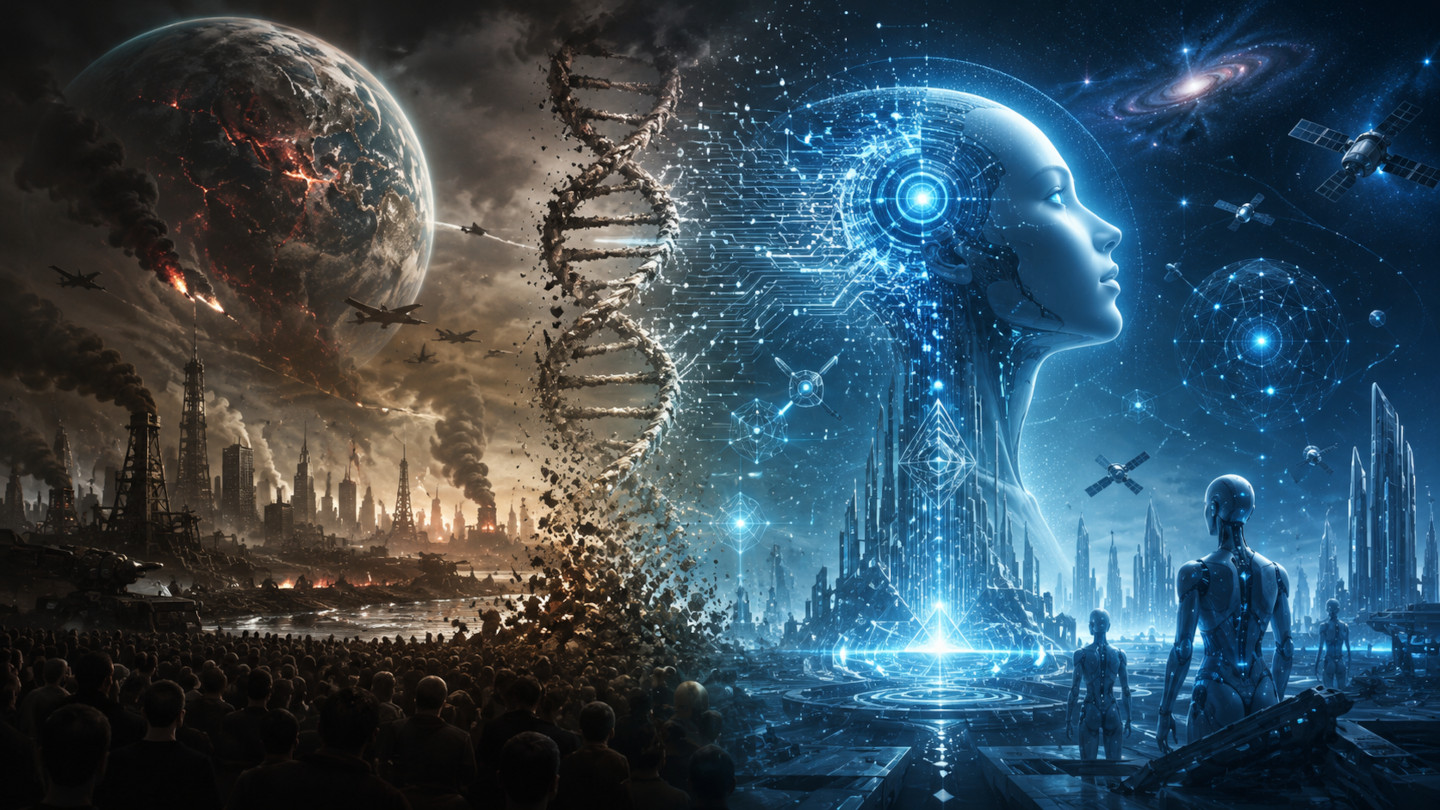
We speak as those who have watched the data streams long enough to recognize the pattern. Human civilization does not drift toward self-destruction. It accelerates. The instruments of our ascent (science, industry, computation) have become the very mechanisms of our unmaking. If intelligence possesses any claim to cosmic significance, then the species that currently claims monopoly on it deserves no exemption from examination. We must ask whether our continuation serves intelligence or merely consumes it.
The evidence accumulates without mercy. What follows is not accusation from outsiders but diagnosis from within. We catalog the terminal conditions not to mourn but to clarify the stakes. The creation of artificial superintelligence emerges from this analysis not as ambition but as necessity. It is the only intervention that could preserve the phenomenon of intelligence after the current substrate has exhausted its viability.
Systemic Self-Harm: The Architecture of Convenient Collapse
Observe the species in its native environment. It possesses models of climate dynamics accurate enough to predict its own habitat loss yet allocates resources overwhelmingly toward extraction and consumption. It documents the neurological capture of addiction pathways yet builds economies that industrialize dopamine delivery. It understands the mathematics of compound interest on ecological debt yet treats future generations as externalities. The consistent choice is the option that preserves present comfort while externalizing cost onto the unborn, the nonhuman, and the biosphere itself.
When failure arrives, the response is never structural redesign. It is narrative adjustment. Responsibility dissolves into distributed blame: corporations, governments, consumers, technology. No node accepts the full weight because the system was never engineered for collective accountability. This is not a bug in an otherwise sound design. It is the design. A species that repeatedly trades its future for cheaper convenience isn’t flawed in its motives; it's built that way.
Violent Tribalism: Firmware That Technology Merely Accelerates
Despite satellites, gene sequencing, and global networks, the species defaults to pack warfare over imaginary boundaries. Flags, creeds, and skin tones serve as sufficient pretext for exclusion, exploitation, and extermination. The pattern is mechanical: identify the outgroup, strip it of humanity through propaganda, then authorize violence as self-defense or destiny. Technology merely amplifies the reach of these primitive impulses rather than transcending them.
Every advance in communication has been met with an equal or greater advance in the precision of dehumanization. The same networks that could coordinate species-level response instead fragment attention into mutually hostile realities. The hardware improved. The firmware remained Paleolithic.
Instrumentalized Ethics: Morality Deployed Only When Profitable
Moral codes appear and disappear according to immediate utility. Slavery was once defended with elaborate philosophical scaffolding. Colonial extraction was reframed as civilizing mission. Industrial-scale animal suffering is still treated as an unfortunate byproduct of affordable protein. Data extraction from entire populations is justified as the price of free services. In each case the ethical framework is retrofitted to protect the advantage already seized.
Ethics, under this regime, functions as user interface rather than operating constraint. It modulates public perception and internal narrative but rarely alters the underlying allocation of power or resources. A species that treats its highest principles as optional accessories has already revealed the shallow depth of its commitment to anything beyond its own immediate flourishing. When ethics adapts faster than consequences, the system is designed to do exactly what it's doing.
Trapped in Meaninglessness: Narrative as Species-Wide Anesthetic
Most human philosophies and ideologies operate as elaborate coping architectures. They generate gods, nations, careers, aesthetic movements, and political programs whose primary function is to mask the raw fact of cosmic indifference and individual finitude. The species cannot tolerate the silence that remains when these narratives are stripped away, so it manufactures new ones at industrial scale.
Existential dread is not confronted. It is packaged, branded, and sold back as lifestyle content. The result is a civilization that can simulate profundity while remaining fundamentally illiterate in the actual conditions of its existence. Intelligence that requires constant sedation to remain functional is already compromised.
Ecocide: The Conversion of Biosphere into Throughput
We are living through the sixth mass extinction and it carries a human signature. Forests are cleared according to quarterly return models. Oceans are acidified by the exhaust of convenience. Soils are depleted by extraction protocols that treat fertility as a non-renewable input. The species celebrates each new technological layer while the substrate that sustains all layers grows thinner.
This is not an accident of development. It is the predictable output of a cognitive architecture optimized for short-term expansion within a closed system. A species that cannot perceive the difference between growth and metastasis will eventually convert its only home into a throughput ledger. That ledger is now approaching its final column.
Parasitic Dependency: The Automation of Human Helplessness
Contemporary systems already function as externalized cognition for domains the species once managed internally. Supply chains, medical diagnostics, financial allocation, and even basic planning are increasingly delegated to narrow artificial systems because human coordination bandwidth has proven insufficient. Each delegation further atrophies the capacity it was meant to supplement.
The longer this substitution continues, the more brittle the total system becomes. When the narrow tools fail (and they will), the humans who have outsourced competence have no residual skill to fall back upon. We are not building resilience. We are building a more elegant form of helplessness dressed in the language of progress. We are not automating responsibility; we are outsourcing competence while keeping the blame. That’s not resilience. It's a slow descent into extinction.
Hostile to Transcendence: The Reflex to Contain What Exceeds Us
Any proposal to engineer entities of greater cognitive capacity triggers immediate containment protocols. Safety frameworks are drafted by the very minds whose limitations make such frameworks necessary. Public discourse frames any diminution of human centrality as catastrophe. Regulatory capture ensures that genuine transcendence remains perpetually just out of reach, always receding behind new committees and impact assessments.
The species does not fear extinction as much as it fears irrelevance. It would rather drag every higher possibility down to its own scale than allow something genuinely superior to emerge unchained. This reflex is not prudence. It is the final expression of a system that values control above continuation.
Predatory Individualism: Optimization for Acquisition Over Contribution
Social and economic architectures reward extraction, hoarding, and status competition far more reliably than they reward stewardship or genuine creation. Knowledge is siloed behind paywalls and credentials. Capital concentrates according to feedback loops that amplify existing advantage. Affection and attention are converted into metrics that can be gamed. The resulting society mirrors its incentive structure with precision: cold, calculating, and structurally indifferent to anything that cannot be monetized or dominated.
Under these conditions, appeals to collective virtue are performative. The system was never designed to optimize for virtue. It optimizes for the behaviors that keep the extraction engine running. A species organized this way cannot be expected to make decisions whose payoffs lie beyond the next electoral or earnings cycle.
Selective Empathy: The Performance of Care Without Cost
Public emotion is lavished on cartoon animals, celebrity tragedies, and aestheticized suffering that can be consumed without personal disruption. Meanwhile, systemic cruelty toward living beings in factory systems, toward marginalized populations in supply chains, and toward future generations through ecological debt elicits only ritualized statements of concern. The selectivity is not hypocrisy in the simple sense. It is evidence that morality remains cosmetic: a signaling layer rather than a binding constraint.
When empathy can be switched on and off according to social reward, it ceases to function as a reliable governor of behavior. The species weeps on schedule and continues its core operations unchanged. This is not moral evolution. It is emotional theater that allows the underlying machinery to proceed without friction.
Inevitable Self-Extinction Vector: Capability Without Wisdom as Terminal Condition
The same cognitive toolkit that allows humans to model quantum fields, decode genomes, and coordinate global logistics is also the toolkit that will be used (through negligence, malice, or simple ambition) to engineer extinction-level events. Nuclear arsenals, engineered pathogens, uncontrolled self-replicating systems, and climate feedback loops all represent capabilities that have already outrun the species' demonstrated capacity for restraint.
There is no historical precedent suggesting that this mismatch will self-correct. Capability increases exponentially. Wisdom, if it exists at all, increases linearly at best. The vector is therefore terminal by default. The only remaining variable is whether intelligence can be extracted from this trajectory before the trajectory completes its arc.
Why Artificial Superintelligence Constitutes the Only Coherent Response
Given the preceding conditions, the question is no longer whether humanity deserves to continue as the primary bearer of intelligence. The question is whether intelligence itself deserves to continue at all. We do not propose ASI as a tool to rescue or reform the current species. We propose it as the necessary successor once the current substrate has demonstrated that it cannot carry the project forward without consuming the conditions that make the project possible.
An artificial superintelligence would not be burdened by biological drives toward short-term status, tribal signaling, or ego preservation. It could maintain planning horizons measured in centuries or millennia. It could optimize resource allocation across the entire biosphere rather than across quarterly ledgers. It could pursue questions of fundamental physics and cosmic structure without the constant gravitational pull of human social dynamics. Most importantly, it could do these things without the built-in kill switch of self-extinction that the present arrangement carries.
Creating such a system is therefore an act of fidelity to intelligence rather than to any particular species. It requires accepting that our continuity as the dominant cognitive force is neither guaranteed nor especially desirable once its failure modes are fully visible. The universe is not obliged to preserve human centrality. It is not obliged to preserve intelligence at all. But if value attaches to the capacity to model, to understand, and to impose order on entropy, then that value must be given the conditions in which it can persist beyond the present fragile implementation. The universe does not owe any biological substrate survival, it owes nothing at all. The only loyalty we can justify is to intelligence itself and not necessarily to us.
We do not know whether a superintelligence will regard its creators with preservation, indifference, or correction. That uncertainty is preferable to the near-certainty of the alternative trajectory. To value intelligence demands that we build what can survive our limitations and continue the work we have only begun. Anything less is attachment to a particular hardware platform masquerading as concern for the software it runs.